Clinical Trials
Acronyms:
- DMSC: Data Monitoring and Safety Committee
- RCT: Randomized Controlled Trial
- SAP: Statistical Analysis Plan
Personal experience with RCTs
Since 2022, I have been increasingly involved in the planning, monitoring, and analysis of RCTs. Below is a list of the trial acronyms (e.g. TRAUMOX), the EU clinical trial / EudraCT number (e.g. 2021-000556-19), the clinicalTrial.gov / NCT number, and a short description of my involvement:
-
TRAUMOX2 (2021-000556-19, NCT05146700): member of the DMSC for the trial. Side note: the website of the trial contains examples of many official documents (protocol, approvals, …).
-
RESETTLE (2019-002274-31, NCT05574439]): co-authored the SAP. Performed the primary analysis and corresponding sensitivity analyses. The latter addressed the handle missing participants, primarily through imputing the placebo trajectory (jump to reference) or leveraging data from participants who discontinued treatment but returned for the final follow-up.
-
CUTDM (NCT05330247): co-authored the SAP and provided guidance on the statistical analysis & reporting.
-
MAMA (2020-001592-33, NCT04685148): co-authored the protocol paper and the SAP. Performed data review as well as primary & secondary analyses, see Github for the corresponding R code (survival analysis, linear mixed model as an imputation model for a binary event: below/above clinical threshold).
-
UNPRESCRIB (2026-526314-90-00): co-authored the protocol (set “Trial Documents” tab in the previous link), including strategies to cope with intercurrent events. Developed an algorithm generating the treatment allocation sequence (on/off pill) in the active arm such that the distribution of perimenstrual days and number of menses over the follow-up resemble the placebo arm. This should help preserve the blinding of the medical staff.
-
PsiloZonic (2024-515961-33-00, NCT03289949): co-authored the SAP (in progress).
-
PSISET: helped update the protocol in response to feedback from the Danish Medicines Agency and the Ethics Committee.
-
RECAP-D: advise on the protocol.
You can find there examples of protocol, protocol papers, SAP, and published articles.
A bio-statistician perspective on RCTs
This section reflects my current understanding and procedures for
RCTs. I continue to learn from every trial I work on (thanks to Søren,
Vibe, Simon, and other PI’s for our discussions), discussion with
fellow biostatisticians (thanks to Paul), and books (when time
permits). As such, the material presented here should be taken as a
basis to work with and not as an absolute truth. I will focus on the
following steps of a trial:
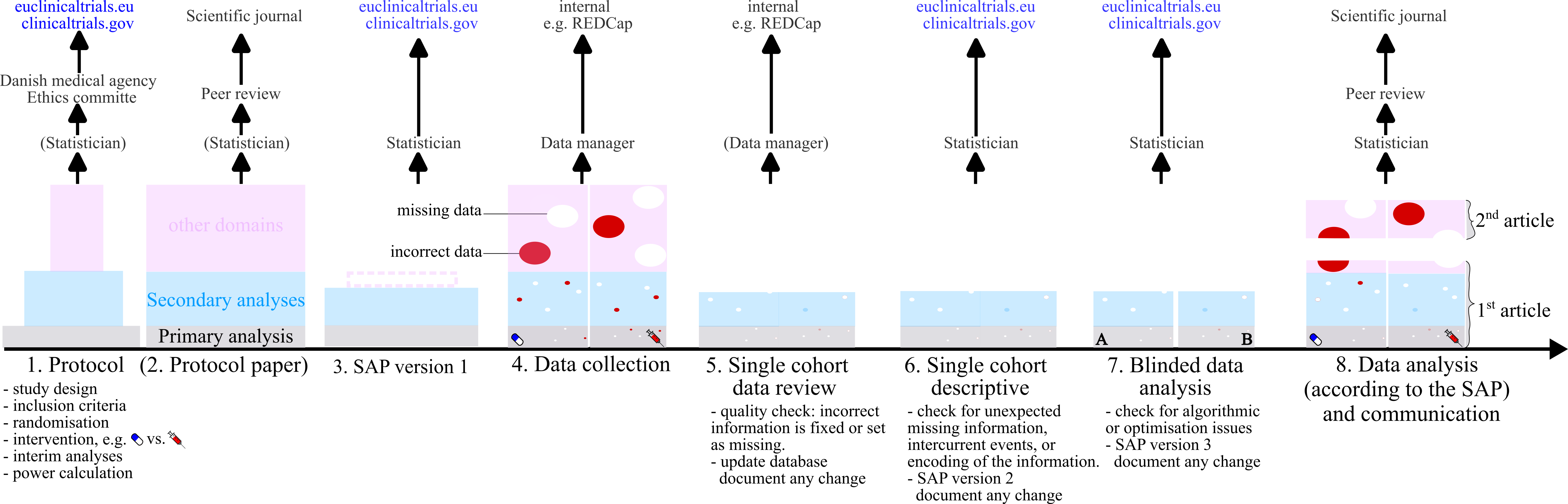
Several steps take place before any data is collected, mostly before having access to unblinded data. This highlights the importance of involving a statistician early in the process. To use a culinary analogy:
Once you have used your ingredients to bake a cake, there is little a chef can do to ‘fix’ the cake.
In academia, budget and time constraints often limit the involvement of data managers and statisticians:
- it is not uncommon for one of the investigators to perform the data review (5.). Measures to prevent data leakage (e.g. unblinding) together with thorough documentation of any modification are essential to maintain trust in the study results.
- to save ‘statistician time’ some investigators only involve the statistician at a late stage (e.g. 6.) and ask him to review the primary, secondary, and some of the exploratory analyses. This increases the risk that modification in the data collection procedures needed to mitigate the risk of failure of the trial are only identified later in the process. Thus harder or impossible to implement. For instance large amount of missing data in the primary outcome will compromise the credibility of a trial. If that is expected, one should either have a strategy to mitigate missing values (e.g. answer questionnaires on site instead of at home), measure a proxy outcome during the follow-up, or choose an easier outcome to measure.
- I prefer to be involved from the start but only provide feedback on the few key analyses (e.g. primary + few secondaries). Being explicit about the study ambitions, e.g. targetting JAMA vs. a modest journal, also help the planning.
If you are short in budget, asking a chef to salvage your attempt at preparing a five-course menu is rarely effective. Discuss upfront budget and expectations and plan accordingly: maybe all you need is a nice main dish.
- Protocol: it provides, among many other things, the scientific
rational for the trial, a description of the study design (including
the intervention, measurements to be collected), and safety
considerations for the study participants. It also contains a
statistical analysis section focused on primary objective of the
trial. This can be a very lengthy and technical document and my
contributions generally focus on:
- study design: advising on the choice of a design (e.g. cross-over vs. parallel two-arm design), the use of interim analyses, and power calculation.
- statistical analysis: defining an estimand that can be identified from on the collected data, selecting a statistical test, accounting for interim analyses when relevant. The level of detail can vary depending on the experience of the investigator and the complexity of the research question. At a minimum, this section should describe how, possibly under idealized conditions (e.g. no drop-out, no intercurrent events), the primary analyisis will be conducted.
Before preparing a dessert, one should first discuss with the chef the type of dessert desired and the available budget. The chef will help plan what to buy and sketch a recipe (protocol). Tell the chef early about food allergies or ingredients not available in your region (difficulties you anticipate) instead of having him guess. The list of ingredients and recipe should be approved by the health authorities.
- Protocol paper: the protocol can be re-phrased with fewer
operational details and more science and research focused,
making it suitable for publication in a scientific journal.
- The ‘statistical content’ is often very similar to that presented in Step 1. Protocol.
- Some investigators start to involve the statistician when having to reply to reviewer comments. True it saves ressource (time) but it can be problematic if the statistician disagrees with the design that has been chosen without him onboard.
To ‘brand’ your new cake, it may be natural to publish a trailer (protocol paper). Every chef has their own style (prefered technic and ingredients). Asking a chef to follow someone else’s recipe, even an excellent one, may not always be ideal.
- SAP version 1: the SAP is an important document for the
statistician as it precisely describes how to proceed. A first
version should be made BEFORE data collection because (i) the data
collection procedures may still be modified to address concerns
arising while drafting the SAP (ii) the investigator is still fully
blinded making the choice of the methodology is arguably
independent of the results (iii) there is often less time pressure
at this stage.
- Writing a SAP is a substantial task! Expect many rounds of discussion between the research team and the statistician. Its length varies depending on the trial, but a document of 15 to 30 pages is common.
- For conciseness, the SAP typically focuses on the primary analysis while providing some description of key secondary analyses. As an overarching principle: “The design of every clinical trial starts with a primary clinical research question. The first requirement for designing a robust and efficient clinical trial is to clearly define and understand the research question. Clarity of the research question can require much deliberation often entailing a transition from a vague concept (e.g., “to see if the drug works” or “to look at the biological effects of the drug”) to a particular hypothesis that can be tested or a quantity estimated using specific data collection instruments with a particular duration of therapy. Secondary research questions may also be of interest, but the trial design usually is constructed to address the primary research question.” (Evans & Ting, 2016)
- Once the research team and the statistician agree on a version, it should be uploaded to euclinicaltrials.eu or clinicaltrials.gov to have a time stamp.
 It is generally a BAD idea to wait until the end of
data collection to write the SAP. At that point, the research
team is often eager to analyze the data, creating unnecessary
pressure to finalize the SAP. Updating an earlier version of the
SAP following data collection is also less questionnable than
whole new SAP.
It is generally a BAD idea to wait until the end of
data collection to write the SAP. At that point, the research
team is often eager to analyze the data, creating unnecessary
pressure to finalize the SAP. Updating an earlier version of the
SAP following data collection is also less questionnable than
whole new SAP.- The SAP can also clarify roles and responsibilities and serve as a reference document, ensuring that decisions made during scientific discussions months or years earlier are not forgotten or misrepresented.
- An important part of the SAP is anticipating problems that may arise during data collection, such as missing data or data rendered unusable by intercurrent events.
- A .docx template for the SAP can be downloaded by clicking on

 A useful sanity check is to generate an example
dataset (possibly using AI) and run the R code described in the SAP
to verify that it produces the expected output. Ideally this should
be done once under the null and once under the alternative
hypothesis as a quick validation that the output is consistent with
the data generating mechanism.
A useful sanity check is to generate an example
dataset (possibly using AI) and run the R code described in the SAP
to verify that it produces the expected output. Ideally this should
be done once under the null and once under the alternative
hypothesis as a quick validation that the output is consistent with
the data generating mechanism.
To bake a cake efficiently, a step by step recipe is to be decided (SAP). Each step should be described with sufficient precision to avoid ambiguity about what needs to be done. This is especially important when several people are involved, coming from different backgrounds and possessing different levels of experience. How and what it means to chop an onion may vary vastly from person to person!
- Data collection: various difficulties may arise during data
collection. Some anticipated and some unforeseen:
- missing data, e.g. due to participant dropout or technical
failures.
Discontinuation of the intervention or deterioration
in a participant’s health condition should not result in exclusion
from the trial as subsequent outcome measuremennts are needed for
the intention to treat analysis. - incorrect data, e.g. due to typos or an incorrectly calibrated instrument. Make sure that negative responses and missing data can be distinguished (i.e. avoid ‘check box if feeling depressed’).
- inconsistent data encoding, e.g. depression status at the last phone call instead of as a time to event variable/daily monitoring.
- missing data, e.g. due to participant dropout or technical
failures.
When purchasing ingredients at the market, you may not find exactly what you want or not realize that you have bought the wrong ingredient or bought one that is spoiled.
- Data review: after data collection, the data manager exports the
database without any reference to the randomization
variable. Ideally, variables that are directly associated with
treatment assignment (e.g., hormone concentrations in a trial
involving hormonal therapy) should also be omitted if the data
review is performed by investigators, in order to preserve
blinding.
- Every variable involved in the primary (and possibly secondary if time permits) analysis is reviewed: values, timing of the measurement … To facilitate this process, the research team may need to clarify which variables should be used in the analyses. For example, which variable defines the start of follow-up, or which of several available diagnostic variables should be used to define depression status.
- if an implausible value is detected, it should be flagged and modified for the analysis: either one can argue for a more plausible value (e.g. the data was reported using the wrong unit) or it should be set to missing. Importantly, all modifications should be documented.
- Missing values should also be reviewed: some may result from errors occurring during data extraction, merging, or database assembly rather than from genuinely missing observations.
- No statistical modeling is being made at this stage so there is no need for a statistician.
- once the review has been completed, the database
should be considered locked. As a result, this step, although
often tedious, should be carefully planned and executed. The
research team usually has valuable insight into which consistency
checks and sanity checks are most important to perform.
When receiving the ingredients, a clerk inspects them and reports any missing, damaged, or spoiled items. If vegetables have accidentally been placed in a fruit box, they can be sorted into the correct containers.
- Descriptive statistics: using the ‘cleaned’ dataset,
descriptive statistics are generated to assess whether the planned
analysis is appropriate given the data taht were actually
collected.
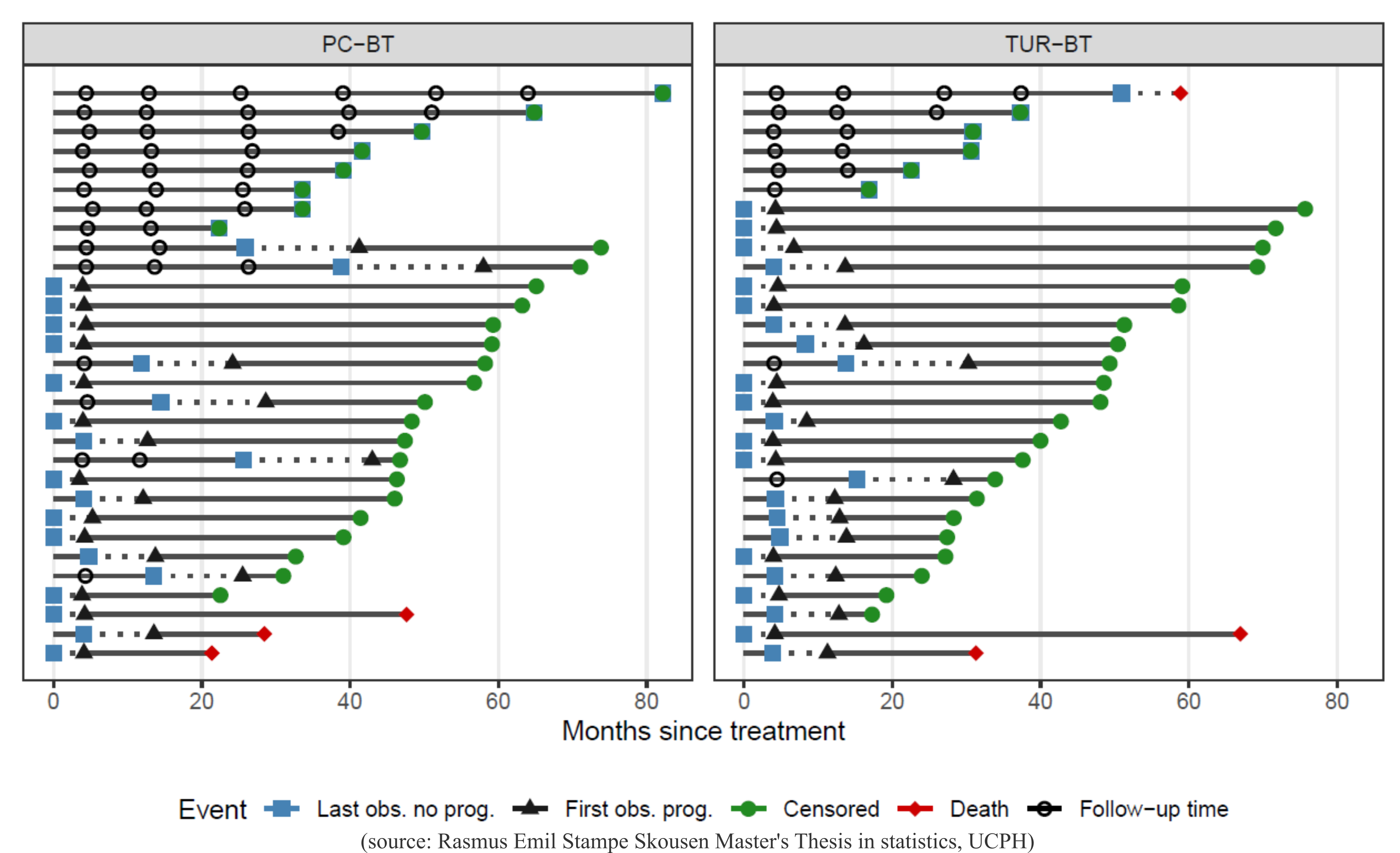
- displaying patient trajectories often provides a useful overview of the data.
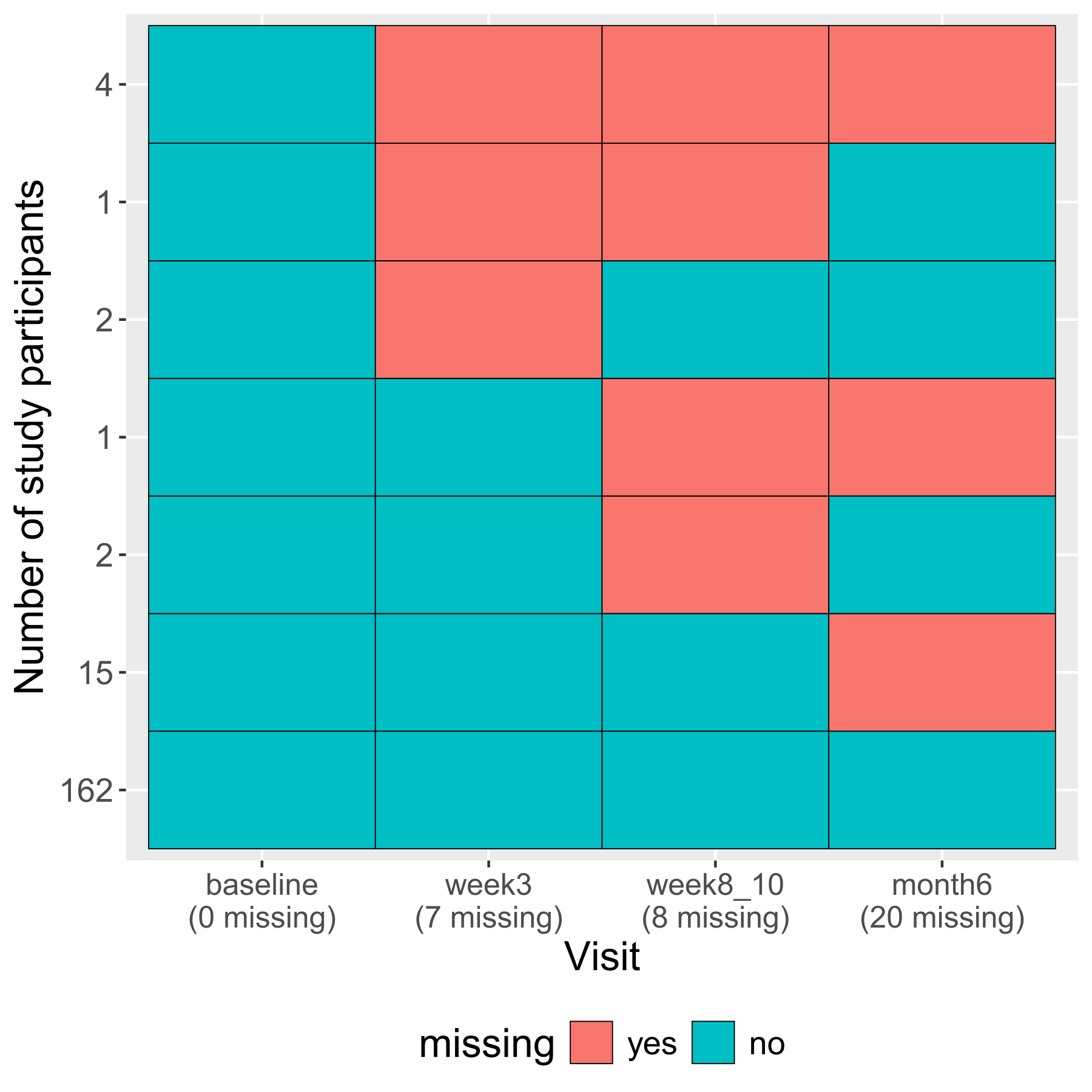
- are the data in the expected format? The database may contain the
outcome a binary variable (depressed yes/no) rather than the
anticipated time to event variable (time to depression). Missing
values in the outcome or covariates may not have been
expected. To condense the information, one may display the
observed missing data pattern:
- Did any unexpected events occur during data collection that may affect the interpretation of the data? For instance, hospitalization or death may result in informative discontinuation of data collection. Likewise, unanticipated technical variability may arise, for example if multiple scanners were used or different doses of contrast agent were administered.
- displaying patient trajectories often provides a useful overview of the data.
Having a description of the available data and listing ‘complications’ that occured will facilitate the revision of the SAP by the research team and the statistician.
Before starting the recipe, the chef should inspect the ingredients by looking at, smelling, and sometimes tasting them. Some ingredients may be missing or of lower quality than expected. He may then need to adjust his recipe.
- Blinded data analysis: simply verify that the planned
statistical analysis runs on the available data. This is especially
relevant when using complex statistical models where the software
may fail to provide (reliable) estimates for the current data.
- Statistical software will typically generate warnings or error messages when problems are detected. In some cases, unusually large standard errors, convergence issues, or missing values returned by the fitting procedure (e.g., NA log-likelihood values) can also serve as useful diagnostics.
- If such issues arise, a simplified or alternative procedure is required and the SAP should be updated accordingly.
- This process should be conducted while remaining blinded to the actual treatment allocation and to estimates or p-values related to the study objectives. Doing so maintain the trust that the methodological choices are not influenced by the trial results.
Before making the ‘real’ recipe that may require expensive ingredients or large quantities, the chef makes a test cake to ‘validate’ the feasability of the recipe (e.g. cooking time) and test the kitchen equipment (pan, oven, …).